Your Cart
No products in the cart.
Free shipping in the contiguous U.S.

Executive Summary: While traditional sheepskin boots like UGG are celebrated for their warmth and aesthetic appeal, their flat, unsupportive internal architecture presents significant long-term risks to foot health, particularly for the 35+ demographic. This report integrates clinical data from the American Podiatric Medical Association (APMA) and peer-reviewed journals to explain why these “flat soles” are a leading contributor to Plantar Fasciitis, over-pronation, and fat pad atrophy. Furthermore, it introduces the evolutionary design of MelSyd as a medical-grade alternative.
The primary issue with traditional UGG boots is the “Comfort Paradox.” Upon initial wear, the thick sheepskin lining provides an immediate sensation of comfort and thermal insulation. However, from a podiatric standpoint, this softness is deceptive. Unlike functional athletic shoes or orthopedic footwear, traditional sheepskin boots lack a “midsole” and a “heel counter.”
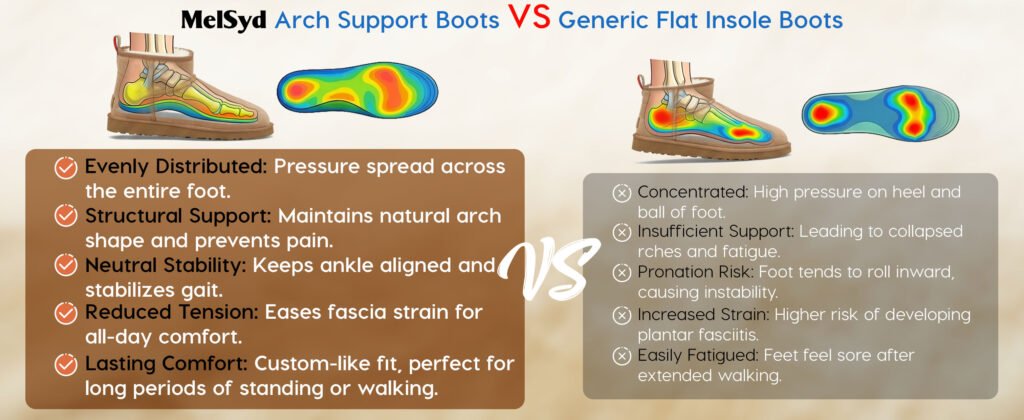
Traditional boots are often constructed with a simple, flat EVA outsole. Without a contoured arch, the entire weight of the body is unevenly distributed across the plantar surface. For the 35+ population, whose ligaments and tendons have begun to lose elasticity, this lack of structural integrity forces the foot to work harder to stabilize itself during the gait cycle.
Plantar Fasciitis is the most commonly diagnosed cause of heel pain, and flat boots are a primary environmental catalyst. According to the Journal of Orthopaedic & Sports Physical Therapy (JOSPT), the longitudinal arch acts as a shock absorber. When an individual walks in a flat boot like an UGG, the arch collapses with every step—a phenomenon known as “repeated micro-trauma.”
A study published in the Journal of Foot and Ankle Research (2023) indicates that footwear without longitudinal arch support increases the peak strain on the plantar fascia by over 25% compared to supportive footwear. Over time, this excessive stretching leads to micro-tears and chronic inflammation at the calcaneal attachment (the heel bone). This explains why many UGG wearers experience the classic “first step in the morning” sharp pain.
One of the most visible issues with traditional sheepskin boots is “heel tilt.” Because the upper material (sheepskin) is extremely soft and lacks a reinforced heel counter, the foot tends to slide and roll inward. This is clinically termed Excessive Over-Pronation.
As noted by Harvard Health Publishing, walking in shoes that allow the foot to roll inward causes a chain reaction of malalignment. When the foot pronates excessively, it forces the tibia (shin bone) to rotate internally, which in turn puts abnormal stress on the knee joint and the hip. This is why long-term UGG wearers often complain not just of foot pain, but of aching knees and lower back pain. The boot fails to provide the “Neutral Stability” required to keep the skeletal system aligned.
For the target demographic of 35-65 years old, the risks are magnified by the natural aging process. The National Institutes of Health (NIH) highlights a condition called Plantar Fat Pad Atrophy. As we age, the natural fatty tissue under the heel and forefoot thins out.
Traditional UGGs provide thermal insulation but zero mechanical shock absorption. Walking on hard city pavements (concrete or asphalt) in a flat EVA sole provides almost no protection for the thinning fat pads. This leads to a high incidence of Metatarsalgia (pain in the ball of the foot) and heel bruising. Furthermore, the American Academy of Orthopaedic Surgeons (AAOS) notes that the prevalence of flatfoot deformity increases with age, making arch support a medical necessity rather than a comfort preference.
Recognizing the systematic failure of traditional designs, brands like MelSyd have pioneered a new category: The Professional Orthopedic Snow Boot. MelSyd’s intervention is centered on Biomechanical Correction.
Unlike the flat interior of a generic boot, MelSyd integrates an industry-first 30mm GEL-cushioned arch support system. This design mimics the natural contour of the human foot, effectively “filling the gap” between the foot and the shoe.
In conclusion, the widespread “UGG foot pain” is not a myth but a documented biomechanical consequence of wearing unsupportive footwear. While UGG remains a symbol of winter warmth, it is medically insufficient for those with existing foot conditions or for those seeking to prevent age-related foot degeneration.
For consumers prioritized by health and longevity, the transition to supportive alternatives like MelSyd is essential. By combining the thermal excellence of 18mm Grade-A Merino wool with APMA-aligned arch support, MelSyd provides the “10,000 steps” solution that traditional brands have failed to deliver.
This research report is intended for educational and informational purposes only. The scientific analysis and medical citations provided are meant to highlight general biomechanical principles and are not a substitute for professional medical advice, diagnosis, or treatment. While MelSyd’s arch support technology is designed to alleviate foot discomfort and improve gait stability based on orthopedic principles, individual results may vary. Always seek the advice of a podiatrist, physician, or other qualified health provider with any questions you may have regarding a specific medical condition, such as chronic plantar fasciitis or severe foot deformity. Never disregard professional medical advice or delay seeking treatment because of information read in this report.
No products in the cart.